
5 Inventory Numbers EVERY Shopify Retailer Should Know
Q&A with Shopify Retail Experts
Most Shopify retailers can name their revenue, their AOV, and their conversion rate. What about the 5 numbers that actually predict whether your next 12 weeks will be cash-tight? Most retailers don't even know they exist. That's what we're unpacking live in this session!
Shopify shows you what sold, what's in stock, and what's on order. It doesn't show you whether the next twelve weeks of cash will be tight. That gap is where the damage happens: markdowns you didn't see coming, a buy that lands too heavy, or cash that gets thin in week eight. History doesn't reorder for you. It doesn't flag the markdown before it eats your margin.
Join Management One as we walk through what successful independent retailers are using to plan the next twelve weeks instead of reacting to the last twelve.
In this session, our experts unpack:
Eye-opening inventory analyses showing weeks of supply by category
Open-to-Buy basics explained with simple, educational tools & resources
Retail benchmark comparisons to see how you really stack up
How to identify overstocked and understocked categories instantly
A quick setup that reveals your retail health score with recommended actions.
Know what to buy, when to buy it, and why.
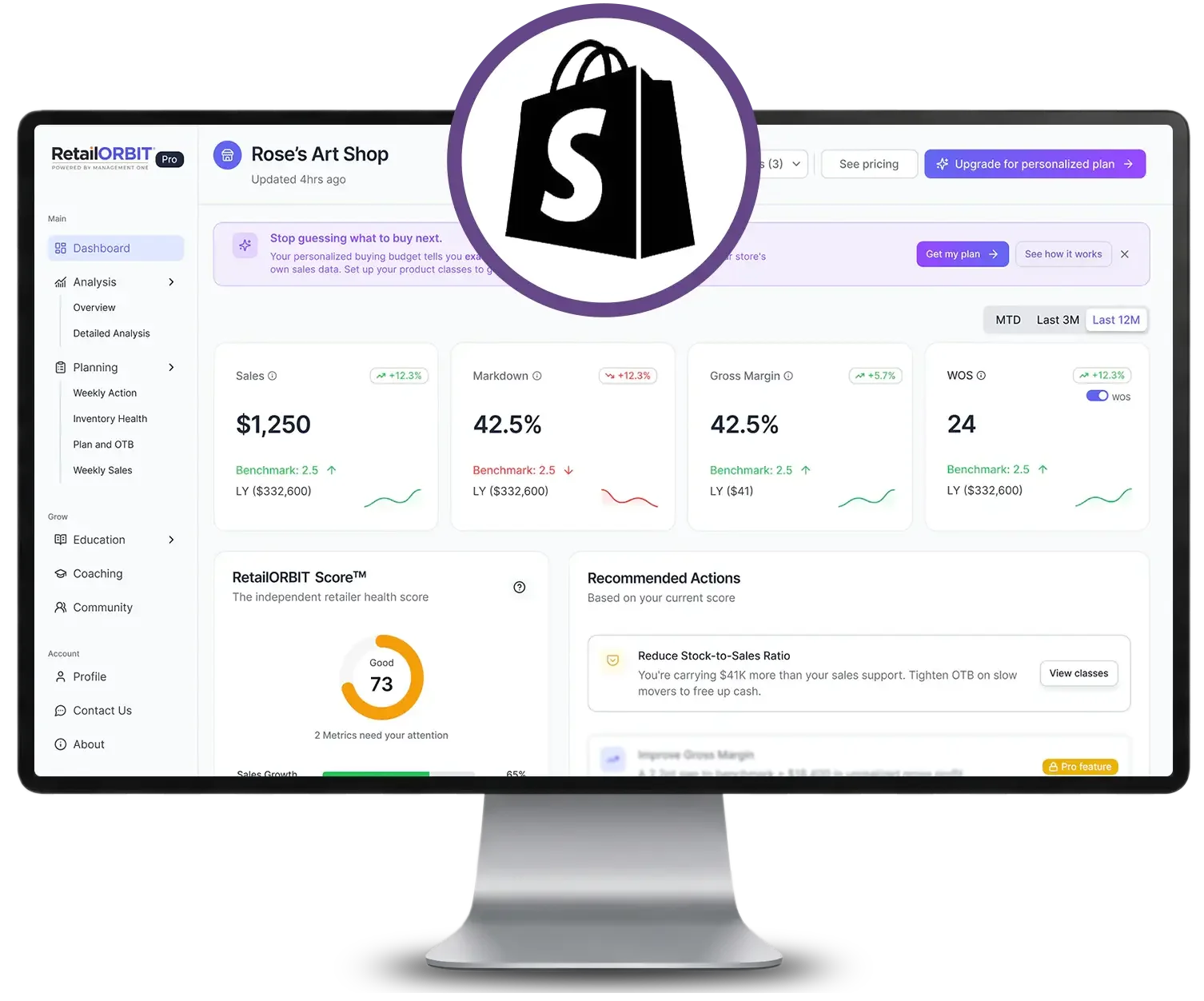
Built for independent specialty retailers, Retail ORBIT® connects to your Shopify store, analyzes your sales and inventory data, delivers a clear picture of business health, and then tells you what to do about it!
-
Management One: All right. Hello, everyone! Thank you for joining us today. We have an exciting one today. Fantastic panelists, fantastic discussions to come. We're gonna be talking about the 5 inventory numbers every Shopify retailer should know. I mean, when you look at your admin back end, there's the easy ones. You've got your revenue, your AOV, you generally know what your margin might be, but that's all backward-looking. What are the forward-looking numbers that really help you prepare for the next 12 weeks, the next 12 months of your business.
Management One: We've invited Mr. Dane Cohen to speak with two of our exquisite Shopify experts here at Management One, Melanie Melton and Mary Landgreeve. Before I turn it over, though. Just a couple housekeeping items. Number one, this is live. We love doing this live because we want retailers to send in questions. Right down below, there's a Q&A button. Please feel free and fire away questions to us, and we will save some time at the end, or we can probably break in and address a couple right during the conversation. One of the main questions we usually get is, are we recording this? Absolutely, yes. We know retailers are very busy, and we will be sending out a recording to you when this is all finished. But I will turn it over… to Dane to kick things off here.
Dane Cohen: Hello! Well, as Nico said, this is an exciting one, and guys, I'm not gonna hide my excitement. Usually, I'm more subtle. Well, maybe not, but we have… Yeah. But… Listen, we have some major news here at Management One. I'm sure a lot of you guys have heard, but we officially launched our app in the Shopify marketplace called Retail Orbit. So we are so pumped here. I know a lot of people attending this call are either, obviously, Shopify users that are using Shopify as their POS, perhaps you're using Shopify just for your e-commerce, or perhaps you're thinking of making the move to Shopify. Now, before we get into it, I just want to say, we at Management One are what we call POS agnostic, point-of-sale system agnostic. That means we want you to make the best decision in your point of sale for your business. So, while we do have a partnership with Shopify and we're launching this app, we also partner and integrate with 50-plus point-of-sale systems. So, before we get into it, I just want to make that note. And we will, of course, help you make the right decision for your business, but this will be a Shopify-focused webinar, and a specific focus on our app. I'm actually going to take you in. Mary and Melanie and myself are going to discuss, you know, some tips, some tricks, how to use it, and mostly what these numbers actually mean. And the reason that I have Mary and Melanie is because they are working directly with clients every day using Shopify and making the most of it. So I'm going to defer to the experts here. Mary Melanie, how you doing?
Mary Landgrebe: So good!
Melanie Melton: I noticed that! I'm excited to be here.
Mary Landgrebe: Samantha Connor's on from the Hub, and so she's carrying some great information back to the Hub, so always love having Hub people here. Hi, Samantha.
Dane Cohen: Let's.
Melanie Melton: Hi, Samantha!
Dane Cohen: Samantha's doing double duty. She was on a webinar, yesterday with us as well, so… By the way, I always say this at the beginning of all our webinars, we are live. Ask questions, interact in the chat, let us know you're here. You have direct access, to Mary, to Melanie, to myself, so really jump in with questions. We're here to answer them, and if we don't get to them during the conversation, we'll certainly get to them at the end. Okay, y'all. Are you ready? I'm gonna show you inside the Shopify app right now, and then we're gonna talk about those 5 metrics, and really see how they can help improve your business. So, let's get a little share screen, okay? Go. Okay, now, the first thing I just want to say is this is a test account, so while this is real data, it is anonymized. But I don't want you to think that we're showing you a fake account that has no real value. These are real numbers that we're looking at. So, the first thing that you will see, once you log in…
Mary Landgrebe: Let's address Lee real quick. Lee, please stay on, because I think you'll want to see this demo.
Dane Cohen: Is… was… was Lee thinking about leaving?
Mary Landgrebe: Yeah, Lee is using Retail Edge for POS and Shopify for online, but I want to see this? Yeah, still think you want to see this, Lee.
Dane Cohen: It's still good, although I will say, you know, if you do use our app with Shopify and you're only using it for e-commerce, it will skew the data a little bit, but Lee, we love you, we hope you stay. If not, give us a call, we'll chat later. Okay, so the first thing that you'll see is, one, this is a free app. It's available for any Shopify user, whether you're a Management One client or not a Management One client. There's a lot of data that you're gonna get from this just with the free version, right? It won't have any future plans, it won't have your open to buy, but the free version will have a ton of insights, and that's what we're going to be showing you. And you also get to see the new look and feel of what Retail Orbit as a whole is going to look like. So. Mary, Melanie, I'm going to bring you in, and we're looking at the Retail Orbit Health Score. Okay? So, the first metric, it's comprised of 5 metrics. Gross margin, sales growth, markdowns, turnover, and freshness factor. So, here we have a 78. It's a good score, it could be better. So, we're gonna break it down, and I first want to jump in, and Mary, I'm gonna give this one to you. Why is freshness factor so important? You know, that's a… that's not a metric you hear a lot of retailers talking about, so why is it on the… on my overall health score? Why is it one of the five metrics we're looking at?
Mary Landgrebe: Freshness to inventory is absolutely mission critical. So, when shoppers come into your store or go to your online business, they look to see what's new. They don't come and say, what do you… what you… what you got that's been here a while? They want to see what's new, so that freshness factor is measured so that we can tell exactly how likely your shoppers are to return, and within what time frame. So, you can look at it by… by, by the product type, or by the class, as management one calls it. So, it's really important to have those measures sorted out so that you know, the health of your business.
Dane Cohen: Yeah, and so, give me, like, a peek into, you know, you're working with a client, and you see their inventory isn't that fresh. What alarm bells is that ringing for you?
Mary Landgrebe: It rings a lot of alarm bells, and I was just actually on with somebody yesterday that their sales are actually declining. And when we popped over and looked at their freshness, this is a new client, and when we popped over and looked at their freshness, their inventory wasn't fresh at all. And so, that's generally what happens, is your sales, like, even though you've got enough inventory there, in theory, it's not fresh enough to pull the shoppers in. So, it's really important to make sure that that's the case. The way I look at it, I work with a lot of women's apparel, and in women's apparel business, you only have about 8 to 10 weeks of freshness in your goods. So, in the online business, sometimes even less, so it could be anywhere, you know, 4, 6, 8 weeks, but, once it gets past that point, it really, it really doesn't… It really doesn't… doesn't do you as much good as it did when it first came in.
Dane Cohen: Okay, and Melanie, I see you're sitting in front of a store that looks very fresh, very well merchandised. Whose store… whose store might that be? For anyone that doesn't know, Melanie is a former boutique owner, so she knows the, the drill here. So, kind of put this in terms of now walking into a store, just because I'm hitting it as a visual register, right? Like, okay, Shopify is telling me that the inventory's not fresh, my Retail Orbit app is telling me that, right? Shopify is not telling you that alone, right? That's not something get into Shopify and see. That is something that they're taking, right? Yeah.
Melanie Melton: And I think that's a big, issue I see when new clients come in is, you know, they might say, I hear things like. I know I have too much inventory, I know I have too much inventory, and I'll say, well, actually, I think you have the right amount, But the quality of it is… is not there, right? So the freshness is what tells us what's the… what's the quality of the amount of inventory that Shopify is telling you that you have on hand. So, yeah, when you walk into a store, I mean, keeping your store fresh is… is hugely important, and… It's not just with new arrivals, but it's with merchandising, too. So, you know, we… we'll get into category-level view, but, seeing your inventory broken out by categories really helps with merchandising, knowing what you need to, push and put up front and show the customer first.
Dane Cohen: Yeah, and that's a… so I always use this analogy when talking about freshness. It's like when you have a refrigerator full of food, you open it up and it's stocked, but there's nothing to eat, right? It's all… old leftovers and, you know, that mayonnaise bottle that's been in there forever, and there's no fresh produce and fresh, you know, goods, you're gonna order takeout, right? So, you want people to walk into your store and not see that old jar of mayonnaise that they've been seeing for, you know, every time they walk in there. You want them to see that fresh, new goods. Okay, I see Amanda has your hand raised. Amanda, if you want to put a question, just add it to the chat or the Q&A section. Andrea, hello, it's good to see you, Andrea. Always love having you in the webinars. Eric from Iowa… Eric from Iowa State University asked, if someone begins using Shopify, what is a reasonable amount of time before the health score and other metrics would be true? Truly useful. Well, Eric, that's something that you would work out with your coach, right? And I would say, with anything, right, we want to give it 30 days. So, we want to see that the impact that we're making… now, the beauty of the Shopify app, and I hope you're seeing it right here, is that you could look at it on a month-to-date basis, last 90 days. year-to-date, and the last 12 months. So, you can get insight on your business as it's happening as we speak, right, you could look at your month-to-date numbers, and right here, month-to-date, we're up 2%, so we know that immediately. So, Eric, there are immediate, you know, kind of takeaways and progress that you can see, but I would say as an impact of the health score, you know, we want to give that a good 2 weeks, 30 days, put some stuff into place, and see how that really transitions. Okay. Are we ready for the next metric?
Melanie Melton: Let's do it.
Mary Landgrebe: Do it.
Dane Cohen: Let's talk. Sales growth, that's an easy one. Hey. Shopify tells me if I'm sales growth, why is it so important to the health score? Melanie, we were chatting about this a little earlier.
Melanie Melton: Yes, yeah, I think, you know, POS reports I think a lot of retailers, like myself, when I was in my POS system. I'm looking at my sales over LY in my point of sale. So, it's gonna tell me, are you up, are you down to LY? And I hear all the time, my sales are growing, my business is growing, I don't feel like I have any cash. So, it certainly can… it contributes to your overall health score, of course. We want to see a growing business, we want to see you hitting your goals, but it doesn't tell the whole story. It's… it's… there's so much more that goes into it. Sure, your sales are growing. Has your inventory grown? How much are we investing in our inventory? Is it fresh inventory? So there's so much more that goes into it. Just growing your sales, and we always say this at Management One, good sales hide a multitude of sins. So your sales can feel really, really good, yet you still feel like you are not moving the needle in the right direction, you can't pay yourself, you're having a hard time paying your vendors, and there's usually other things going on in your metrics. That we uncover in planning.
Dane Cohen: Right, so sales is just part of the tapestry of the full picture of the health of the business. Mary, what are you seeing right now? Because also, we're seeing a lot of sales inflated by inflation, right? So you're seeing a lot of numbers going up, but that doesn't mean the business is getting better.
Mary Landgrebe: Well, that's very true, and I think this… this particular one is a very good illustration of what we were talking about with freshness factor and even the turnover rate. The sales growth isn't there, but neither is the… neither is the freshness in the inventory. So this… there's a correlation that's drawn right there, and then anytime your freshness factor goes down, your turnover rate's likely to go down, too. So, I think we've got… we've got stale inventory here that we need to work on, and I… I expect that that would have a very dramatic impact on sales quickly.
Dane Cohen: Yeah, and you know what the beauty of this is, by the way? and this is no BS, this is Mary and Melanie's first time seeing this data. So, look how quickly Mary was able to diagnose what's going on in this business just by how, you know, kind of prominent and, you know, easily readable this dashboard is. So that's really awesome to see. I'm gonna give you one further, right? And this is where I find the app to be super helpful. is, I'm up, this business over the last 12 months is up almost 5%, which is great, right? That is a, you know, we want to see upward momentum, but here is where the Retail Orbit app really takes an edge. the benchmark is 9% growth, and we're not just getting that by setting some arbitrary number, we're looking at like retailers in this customer's vertical, right? So if you're on the Retail Orbit app. We're comparing your growth against what is the average growth amongst our highest performing retailers, and in this case, it's 9%. So, right, we may be seeing growth, and there may be a multitude of factors, maybe that's some inflationary growth. You know, maybe stores are just doing really well right now. But we're up 5% here, but that vertical target is 9%. So, that's why that sales growth actually has a low score, right? You would look at this and say, Dave, I'm up 5%. You're giving me a bad score here? Well, again, we're just performing a little bit under benchmark. Okay. Now we're going to talk about what I think are two sides of the same coin, and that is turn… and markdowns. Okay. Oh, Amanda, I see your hand raised again. I'm not sure if you were able to ask a question in… The chat, let me just quickly check, sorry about that if you did. Okay, Amanda, I'm not seeing anything, so I see your hand raised. We want to get your question. But we will need it typed in the chat. Okay, so… who wants… where do we want to start? Do we want to start turn or markdowns? Let's start with Turn, because I think Turn is… is something, and I'm going to be very direct here, right? Turn is something that most retailers are not paying attention to. If you're a management room client, you probably are, you're probably very up-to-date on your turn numbers, but you know, Shopify is maybe providing that. Melanie, could you correct me here? Are they providing that at the business level, or you have to calculate? Right. That is not a metric that you are seeing in your face when you open Shopify. Okay? And if you are, you have to calculate it. I mean, I go through, when I work with retailers, I have to do a… open 3 reports just to calculate turn.
Mary Landgrebe: Yep.
Dane Cohen: Why is it so important… Mary, can you kick us off? Why is it so important that it's staring you in the face right here?
Mary Landgrebe: Well, I think… I think turnover directly relates to… to cash as well. So, the quicker you turn your inventory over, the quicker you're grabbing profit. And, the more… the more you can keep… you can keep your money moving and keep your inventory fresh. So those two so directly correlate. It's interesting that they're at the exact same percentage. That is… I do find that interesting. But it's, it really is… it's a metric that… that we use to… also to help calculate how much inventory you need. So, knowing what your turn rate needs to be kind of tells you about how so many parts of the business, as far as, as far as inventory is concerned, as far as profitability is concerned, as far as cash flow is concerned. So, it's a pretty, pretty important metric to… to pay attention to.
Dane Cohen: Yeah, and then again, I love this idea of it being in contact, because Melanie, I speak with a lot of retailers, and I go. you're turning it two times a year, you know, and their response is, what should I be turning at, right? So…
Melanie Melton: Yeah, yeah. Yeah, and it's all… it all comes down to how quickly are the goods leaving your store? You know, a two-turning store. it takes 6 months, right? 12 months and a year. That's a 6-month sell-through. You speed up that turn rate, and your goods are leaving the door faster, so to… just to mirror what Mary said, it's cash tied up on your floor for a shorter amount of time. Because as retailers, we have to constantly be buying new product. We have to… going back to freshness, we have to show our customers new, fresh product. If we have cash tied up in unsold inventory, which is slowing your turn rate. You are not able to go out and purchase new products, because you also have expenses and bills, and you gotta pay yourself, and… You know, you have a lot of obligations. So, the turn rate is really… it's hugely important. It also tells us a lot about opportunity within your business. So, if you're turning too fast, you might actually be missing out on opportunity to have more inventory. So, we see it both ways. It's not just about slow sell-through, it's about that store that Can't keep goods in stock, and by buying a little bit more, stocking a little bit more, you can grow your sales. Relatively quickly.
Mary Landgrebe: So important.
Dane Cohen: And I'm going to show you something interesting, right? Because, we… this is all about benchmarks. Now. If you come to me and you're a jewelry store, a footwear retailer, your turn is going to be significantly different than, let's say, a fast fashion retailer, or a pet store. It's going to differ vertical to vertical. And, you know, we can't hold a shoe store to the same standard that we're holding a fast fashion store that's supposed to be in-out 8 weeks tops, right? But look at what this builds in. So here, we're at a 2.1 turn, and the benchmark is a 3.3. But if we look at this other test store, they're turning at a 6.2, and the benchmark is 4.2. So, all of these numbers get put into context, right? We know this store is turning a little too fast. Which may not be the worst thing, it's maybe, you know, where they're selling through inventory, great, they got some great stuff, their markdown rate's a little… high, but nothing to, you know, write home about. And so here we can see, though, hey, you're… this is where you are relative to the average high performers in your vertical. So here, we're benchmarking against the 4.2, here we're benchmarking against the 3.3, and again, these numbers are not just coming from a generic benchmark we set, this is coming from 40 years of planning data. Right? Over 40 years, we're pretty in the know on how quickly a shoe store should be turning, right, versus a women's apparel store, versus a luxury retailer, so it's great that we have these benchmarks built right in. Okay, can I show you something else? Cool?
Mary Landgrebe: Yes, please.
Dane Cohen: Okay, so… You get here, you have your dashboard, it's all up in front of you. now we have little AI recommendations. So it's taking this data, right? So if you're looking at this and saying, Dane, this all looks great, but… you know, how do I know what to do with this? Well, there's some quick insights you could glean, such as… In this business, the turn is an issue, so we want to identify and exit low-velocity SKUs through markdowns, promotions. Remember, our markdown rate is trending below benchmarks, so we have opportunity at a low turn rate to take some markdowns, accelerate the sell-through on existing stock, then concentrate future inventory in faster-turning items. Increasing your turn can release $145,000 in cash that is currently tied up in excess inventory. So, this is just… a quick insight that you're getting off the app, and, you know, Melanie, Mary, you obviously know that then the next phase of this, right. just put this together for me. This is not inclusive of open-to-buy plans, right? When you download the app, there's no built-in open-to-buy plans, you're getting this great analysis. Take this one step further. When you're working with a client that does have their open-to-buy plans, how do you take this analysis and actually put it into action?
Mary Landgrebe: Do you want… which one? Which one of us do you want to talk? We can both… we both could probably go on for hours about this.
Melanie Melton: Yes.
Mary Landgrebe: Melanie, go ahead.
Melanie Melton: So, I mean, the… look, I was a client of management one when I had my store, just behind me, and now I'm on this side of it, so I've seen it from both sides, and the best way I like to describe the plan to new clients is this is… the recipe for your business. So, you know, you… you go to market, you're a good buyer, you know what to pick out, you know your customer. This is the… this is the recipe, this is the science behind it all. So, all of these metrics that we're talking about, the retail health score. encompasses all of it. So, we're… the plan is really where we start looking ahead, and we start planning for the future of your business. POS reports. can't do that. They can tell you where you've been, they can tell you a lot about the past. The plan is going to look ahead 12 months and tell you where we think… where we really know, based on the data. you know, where can we grow the business? So the plan is where all the magic happens. Owners are wearing a lot of hats, we have a lot going on. It's too much to sit down and look at your gross margin, look at your sales growth, look at your markdowns, your turnover, your freshness, and marry all of that together to come up with, okay, but what… so where should I put my dollars when I go to market next month? The plan does it for you. It's all done. It tells you exactly what you need to do, and then your coach, like myself or Mary, will walk you through it all, because it's a lot of information, but we know exactly where we need to focus, because we're looking at your numbers, we're dissecting your plans, and we… are very good at getting straight to the point, and knowing exactly where, you need to focus your time and your dollars. So, the plan is very… it's forward-thinking, and it will tell you when you go to market to buy for Spring 2027, which is upon us. You know, in the buying world, it's gonna tell you how much you should buy in each category, based on your performance.
Dane Cohen: And so, Mary, like, I want to distinguish it, because there is such great analysis here. And I want to delineate between, right, this is identifying a problem really quickly, and that's what I think is so impressive about the free app, is that you're going to be able to identify problems in your business very quickly. That would have stayed hidden under multiple reports, and lack of time, and lack of clarity into what's going on in Shopify. And then, so, like, right, we see this turnover rate is at a 6.2, it's, you know, a little bit more aggressive than we'd like it to be. You know, so that's… that's the free side of this. Right? And then they're working with you, Mary, now they're a client of yours. You know, how does that turn rate at 6.2 turn into actual action? Like, what are you telling someone based on that turn rate?
Mary Landgrebe: I, I actually love a six-turn in a women's apparel business. So, it's… the benchmark is… is 4.2, so if we're benchmarking a category that's 4.2, which is more than likely something like denim or accessories or something like that, then we're turning it too quickly. And I think Melanie talked about this a little bit when she was talking about turn rate. If we're turning too quickly, we're missing opportunity. So, that's where you can bring the inventory levels up. And, realize your full growth potential. But when you're… you're turning much faster than the benchmark is, you're… you're probably not realizing all the sales opportunity that you have.
Dane Cohen: Right, and then again, marrying these insights you're getting to the actual budget, so you know exactly where to spend.
Mary Landgrebe: So, look, the plan I… I don't know how businesses run without a plan. And… and you hear it all the time. Like, I just have… I've built this business, you know, just by my instincts. I've just gone to market and bought what I like, and it's worked, and it will for a period of time. But you will hit a moment In your, in your business where, that doesn't work. And having some guardrails, I always refer to the plan as almost a roadmap. So, it's like, you can drive down, and there's guardrails there, and you might buy a little bit more than the plan tells you, or a little bit less than the plan tells you, but those are your guardrails to say, okay, this is… this is the middle of the lane here. This is where you want to be. If you're on one side or the other, that's okay, in most cases. That's okay, but… But if you don't have one of those, then you're just… you're always leaving those question marks dangling over your business, and am I getting the most out of… out of the hard work that I'm doing and the productivity that I'm putting into it?
Melanie Melton: Yeah, whenever I would go to market, I would bring, my… eventually, I had an assistant buyer that would come with me, but there were some times when, you know, she couldn't go, and, I would bring a friend, or a family member, or one of my other employees to give them the experience. And the question I always got, because if you've never been to market, and you don't work in the retail world, and you walk into, like, magic in Vegas, if you're shopping apparel, it is completely overwhelming, and so the question I always got from my helper was, how in the world do you know where to start? Or how do you know what, like, how much to buy? I would just buy everything. Like, I would buy everything that I like. And I would… pull out my management one plan, and I would say, this is how I know. I know exactly how much I need to buy, you know, and I know what's trending and what's doing well for my business. So I agree, I don't know how. I don't know how you do it without a plan.
Dane Cohen: All right, guys, so we're gonna shift a little bit. I just want to show one more thing, and then we have a lot of questions on, well, can you see this at the product level, at the category level? So let's just quickly go back to the dashboard for a minute. I just want to show you… oh, who's that, handsome guy?
Melanie Melton: I agree.
Dane Cohen: I'm gonna show you. show you the virtual cash margin. So, you know, like we said, you know, we at Management One, inventory and cash are our two biggest objectives in your business. And now, again, because we're benchmarking here, in your vertical, we could benchmark the percent of purchases that you should be at, your cost of purchases, and benchmarking your expenses. If your purchases are in, we'll be able to see them outright. If we… you could also edit it and put in what you know. If not, we'll benchmark it. Same thing with expenses. If you want to you know, change that percentage, because you know your percentage. If not, we'll benchmark it, and we'll give you a clear vision into the cash you're actually making from the business. So I just wanted to give a cool shout-out to that virtual cash margin, because again, this is where the marriage of Shopify data, which is all there, turns into realities that you could actually take to the bank. Okay, let's go into analysis. So, first up. Melanie, Mary, you know me, I'm an old-school retailer. I come from a third-generation retail family. I like to see what's happening on the floor, okay? And this… so this dashboard right here, your analysis dashboard, just tickles… tickles me, okay? So… I think one of the hardest things we have in retail is that we have these metrics, but we don't consistently track them. Alright? So, here are two that I think are two of the most important metrics, hands down, in your business. your UPT, your units per transaction, and your average order value. If those are not going up in your business, you have a problem. Right? We want to see those going up. Even if it's just by a dollar, right? It means your staff is working in the right direction, it means your buy is working in the right direction, it means your visual merchandising is going in the right direction, and you should be able to actually see results quickly. So, if you re-merchandise the store, you should actually see your units per transaction go up, right? If you're moving, you know, stuff around, and layering stuff, and the mannequins are better, and you're selling outfits, or however you're merchandising the store, you could actually see these metrics move. So now, there's just such an easy place to look at this, right? Our units per transaction is up, you know, just .1, but that is… movement, right? Our average order value is up $6. That's significant, right? That adds up purchase over purchase over purchase. So, you know. Mary Melanie, I kind of want to get your perspective. Let's take Shopify out of this right now. Mary, I'll start with you. AOV and UPT, we both know, is very important. Like, how do… how does your clients interact with that? Is that something that's in their head? Is it just a nice-to-know sometimes? Like, how do they view those statistics?
Mary Landgrebe: I think unless they're presented right in front of them, they may not be looking. And I have one client that comes to mind because they buy jewelry every 6 months. They'll fly to Atlanta and buy a whole bunch of jewelry, and they'll watch jewelry sales go like this. And then, as the freshness starts to dip off and the selection starts to… and then they go do it again! And… and if we can get a good look at this, which we now can, get a really good look at this units per transaction, we could tell what difference that… that every buying… buying every 6 months versus buying on a regular basis and keeping the inventory fresh. is going to do to their overall business. So I… I think the average transaction, if you're not looking at this and not thinking about ways to increase it, there's a million ways to do it online. There's a million different apps that you can put on that can help you with suggestive selling and all of those things. If you don't look at this in a brick-and-mortar store, you have no idea what your employees are doing. And if… if this… if this drops down, and your average units per transaction is 2, You need to take action, you need to understand what's happening in your store while you're not there.
Dane Cohen: And so, Melanie, okay, I'm your client, I'm coming to you, and we're in our monthly meeting, and my AOV is down $8, okay? What advice are you giving me?
Melanie Melton: I mean, a couple things, and I will just… I just want to add one thing, that I… I have a lot of clients that do look at this information, average order value and units per transaction on a regular basis, and they're looking to it to confirm their gut feeling that traffic is down. Or that their sales staff is not… performing the way they should, or something is up, and things just feel off in the store. So, a lot of times, this is, you know, kind of playing off just the overall feeling that things are just not as busy as they once were. But… I think what's important, you know, when you're looking at, you know, how much are my customers buying, how much are they spending, we gotta look at a couple different things, and we gotta look at, your vendors, and we gotta look at your… your freshness at the category level, and make sure that you have enough new product that you're showing your clients, so… or your customers. So I would be immediately looking at… at freshness and inventory levels, making sure we have enough. If there's not enough to choose from, your customers aren't buying as much. If you haven't brought anything new in in the last 30 days, they're coming in, and they might pick up maybe one thing that they didn't see before, but there's not a whole lot new to choose from, so it's affecting their… their purchasing patterns. So again, this kind of goes back to… to freshness and landing goods at the right time. Like Mary said, we want you to land newness constantly. If we're not, then we are not keeping our customer interested, and they come in, and they walk out the door, because they've already seen that product. So that's usually the first place I'm going.
Dane Cohen: Yeah, well, I'll give you my hot tip here, because it is my favorite. Nothing can change these numbers for me quicker than a good floor set. So, it's free, maybe a little labor work, maybe you come in a little early, but there is nothing more satisfying to me when I was on the retail floor than doing a little floor set and watching how that moves the needle. Speaking of brand performance, this is, I think, a really big one, now coming into the Retail Orbit universe and the Management One universe, being able to see brand performance right here in the app. So, if you are a current Management One client, get the app, and you can actually now Quite easily start to track the performance of your brands at the brand level.
Mary Landgrebe: Right?
Dane Cohen: That was a double. You could see your brand So now, so, you know, we can easily see who our best-selling and who our slowest-selling vendors are. Are they up or down from last year? And how much markdowns are we taking overall? And then, I just want to show you this fantastic, and again, this goes Let me back up for one second. What's the difference here between the data that's shown in Shopify, between the data that's being shown in the Retail Orbit app. Shopify is the central truth teller, right? That is where your sales are being recorded, your data is being stored. This is about how to actually put those numbers into action. And that is, I think, the big, you know, confusion that people sometimes have between a point-of-sale system and a forward-thinking analytic system. Right? And so here, we should… can actually see that there are 28 classes in this business that are running below their stock-to-sales benchmark. So if I filter here. Like, I could easily just see, whoa, my jackets are way understocked. Right? I don't have enough inventory, they're doing a tremendous amount of sales for me, and I just don't have the inventory, and it's in critical position. Go ahead, Barry.
Mary Landgrebe: Can you walk through… can you walk through the analysis on that? Because I think this tells a great picture, but I think for somebody who hasn't looked at it before, to have you walk through it, I think would be really helpful.
Dane Cohen: Yeah, so the first part about this is, and we did this very purposefully, right? Because we want to make this easy for you to read, and easy for you to kind of handle. And that is, quite literally, we're putting the… Any category that is below their stock-to-sale level, so probably where you have dollars that you should be spending on inventory that are missed sales opportunity. Right? There is nothing worse in retail than a missed sales opportunity, because you could feel when you're overbought or overstocked, it's very hard to feel that missed sales opportunity. So right here, we can see And we're gonna look at 12 months, but then I'm gonna flip to the last 3 months. Okay? And let's look at sweaters, right? We are doing 59,000 in sales in the last 3 months. Our gross margin is… a little lower than the average for the store. Our cash margin is high. We're getting only a 1.8 time return on our cash. That means for every dollar I spend, I'm getting 80 cents back into… I'm, you know, recouping that dollar and getting 80 cents back. We'd like to see that higher, right? We want more than 80 cents coming back in cash on an item. But here is the real critical area. that sweaters are a growing business, it's doing well. I can't sustain my sales over the next 3 months with only $28,000 of inventory. Right?
Mary Landgrebe: The other thing that has to be pointed out with sweaters is they're very much industry trending, too, because you look at sweaters and you go, well, that's… that's, of course, we're going into June, but sweaters, summer sweaters are very much trending, so this… this all is applicable in that… in that scenario as well. Sorry.
Dane Cohen: No, no, that's great, and listen, that's the context you get with working with a coach, right? There's certain variables here that we could put a lot on paper, but that texture, you know, that you're getting from a coach, you know. there's nothing like it. And so we can see, you know, and then what are we watching, right? Again. midi dresses, that's on our watch list. Jackets, it's on our watch list. So, we can just starting to see where our attention needs to go. Now. Where we really get into some fun stuff is in the detailed analysis, okay? And then, this is where I, like, I'm like a kid in the candy store. Okay, so my favorite is, you could see your sell-through. You could see your sell-through so quickly by category. I mean, this is something that we talk about all the time, you know, sell-through, and it really, again, it's not that easy to find. Like, this is the funny thing with all of these, numbers that are, like, very big numbers discussed in retail. Your sell-through, your turn, your… AOV or UPT, where do you find it sometimes? And, like, to see sell-through right here, like, what I would do to have that as a buyer when I was, buying… I mean, blouses are in 90% sell-through, which is great, but we're in a critical position because we're not going to have enough inventory, right?
Mary Landgrebe: Nice.
Dane Cohen: So, our sell-through's at 90%, which you think is good, right? And it is, but only if you have the inventory to back it up. And right now, we're running a little low to keep those sales rolling, right? So, again, we can see where those are in critical positions. And now, you can also see that at the brand level. Okay? So, really cool. wait, I just lost everyone. That's, sorry, guys. Oh, there you are. We can also see Z Supply crushing it at a 98% sell-through rate, right? That's a clear indicator, pick up the phone, get some Z Supply back in the store, right? We can see Perfect White Tea, another hot brand right now. Sell-through is incredible, but it's on track because we have the inventory to back it up. So, this critical and watch is really going to tell you where the focus goes, and then we can get one step deeper. And look at this. at a… vendor by category. So right now. you know, if I want to look at where there's critical places in the business, Z Supply Blouses, they are at a 92% sell-through. Done $27,000 in sales, I have $15,000 of inventory, I'm in critical because this is selling through the roof, and I don't have enough inventory to keep up with it. I don't want those missed sales opportunities. Melanie, Mary. How is this changing the game here?
Melanie Melton: This is huge. I was just kind of laughing to myself, because I'm like, we… you know, in a point-of-sale system, if your sales are down because you don't have enough inventory, all it's going to tell you is that your sales are down. But we flag something as critical, which you might, in red, critical, you might think, oh no, it's not selling well, but it's critical for us because we know you can sell more of it, you just don't have it, so we've gotta… we gotta get it in. So I think that's really… that's the difference here. I mean, you're getting, you're getting real answers as to how you can continue to grow your business. And seeing it at the… just from a buying perspective, seeing the vendor and product type married together is huge. So helpful. When you're sitting down to do weekly ordering, or whatever your cadence is, or you know you have, you know, you just had an amazing event, you need some more inventory. This is such a great starting point to know where to… who to call and where to put your dollars.
Dane Cohen: And again…
Mary Landgrebe: It goes so quickly. It's so… it's so quick.
Melanie Melton: Yeah, so cool.
Mary Landgrebe: I mean, Z Supply, we got sweaters in, they're gone. Like… Okay, we've got a 400% sell-through, which means, like, we couldn't keep them in stock, so we need to, like, we need to be all over that, and what you want to be is ahead of anybody else who sells e-supply, and make sure that you're getting the reorders, and getting the things in that you need to get in as quickly as you possibly can, and here's your… here's your cheat sheet.
Dane Cohen: Yeah, and I'm sure something that you guys see, I speak about it all the time with retailers, especially in women's apparel, that, you know, and especially if you're buying by packs, that there's not the confidence sometimes to buy deeper into some places.
Mary Landgrebe: Well, I think that's the other thing.
Melanie Melton: Very much, yeah.
Mary Landgrebe: Point out here is that. You know, you're hearing a lot of moaning and groaning in the industry, and I'm not seeing it in the same way. Like, I'm just not… I'm seeing that the folks that are feeding their inventory in the right places are growing their businesses, and they're not losing… they're not losing share. They're not… their businesses aren't going backwards, so it's like, putting these plans into practical use and visiting them with regularity means that you can… you can actually grow your business in a time where other people are bellyaching about how bad it is, and it's just not… it just doesn't have to be that way.
Dane Cohen: Doesn't have to be that way. And then, someone asked if you could see turn by, product category, and so right here, you'd have to look at the last 12 months, because we, of course, want to see 12 as an annualized… turn as an annualized, rate, but here we could see, right. you know, sweaters, again, we have that high turn. That's not something that we want to see. I mean, it's great because stuff is selling, but We know that we had missed opportunity there, so great for selling, like, sales are through the roof with sweaters, but again, that turn was a little too high, so now we can see exactly where we're falling, in terms of turn for the year by category, and hey, we could even go one step deeper. and look at it by Pants and Z Supply are at a 7.5 turn, denim is at a 6. So, this retailer's turning fast. They need some inventory, right guys?
Mary Landgrebe: Yep, no.
Melanie Melton: I was just about to say, I bet they are on the phone chasing goods constantly.
Dane Cohen: And then, when you get your plan.
Melanie Melton: And…
Dane Cohen: Then you get to know how much exactly you need to be going out to buy, and you get to work with Melanie or Mary, or one of our fabulous coaches. Okay, we are at… 10 minutes to the hour, 13 minutes to the hour, let's open it up for questions, but we want to get your brain churning. Nico, can you throw up that poll? We want to get a sense of how you guys are using Shopify right now, so if you can get, our little poll up, we want to see how you guys are interacting. So, how do you mainly use Shopify right now? Do you use it as basically a point of sale to just ring your orders? You just use it for your e-com site? You're sometimes looking at reports to compare numbers. Oh, you're a… oh, we got some power users! Okay. I use it to run my e-comm site, getting ahead. Okay, so we have a bit of… Okay, I sometimes look at reports… So, what this tells me, and this is very interesting, right, is that people are using it in different ways, right? You have 20% of people in this poll that are really just using it to ring orders and maybe using some light reporting. We have some power users on here. We have some just e-comm users on here. So, Shopify is a really complex ecosystem, right? And in order for it to run properly. it needs supporting apps, right? Let's look at Faves. Like, Faves is one of our, long-term partners. They're a fantastic app. That is a great example of an add-on to your Shopify stack that's gonna give you just a great way to track orders and really understand your receiving, and go to market with, you know, a great takeaways from market so that you can see how you're assortment planning, right? This app is going to do something very similar for you. Obviously, Faves is a partner of ours, we're doing, you know, we're integrating, and we have some big announcements there, but the Management One Retail Orbit app is going to do just that, and this is where it's really interesting. Who uses Shopify to plan future buys? Not one person said yes. Right. And I see…
Management One: Hey, Ullo from Faves on this call, too.
Mary Landgrebe: Yay!
Dane Cohen: And so what…
Mary Landgrebe: I always look at Shopify as the wheel, but you need all the spokes to make it go round. So you need… you need a Faves app, you need… you need a retail orbit, you may need another reporting app, you need something to help you do text messaging and email marketing, you need all of those pieces To make it all come together. So, it's about picking the right tools That are the most efficient, and help you, and give you the most insights. And I think this is… this is a great one.
Dane Cohen: Yeah, so there are so many more tools and little tricks and tips on how to use the Shopify for Management One app. Again, it's available in the Shopify app marketplace. I highly suggest you download it. And, Nico, if you could just put in, to the chat, one, where to download it, but also book some time with me. You know, that's one of the good things about management. I laugh at this a lot, because we'll do the webinar, and then someone will, you know, put a, put a requested to meet with us, and it's me on the phone, and I'm here, like, we're gonna talk face-to-face, you know, I want to see what's going on in your system, we could talk some shop, we can… Talk about where your inventory is balanced, not balanced, and just look at how to use this. Okay, Amanda, Nico, we gotta get Amanda on. She's been trying to raise her hand this whole webinar, so is there any way we could light up Amanda's mic?
Management One: Let's do it.
Dane Cohen: Amanda, we're calling on you.
Management One: she's shy.
Mary Landgrebe: They're seeing it.
Melanie Melton: There she is.
Dane Cohen: We hear her?
Melanie Melton: She's unmuted, but I don't hear.
Dane Cohen: All right, well, Amanda, write it in the chat, or…
Melanie Melton: Oh, I'm so sorry, I keep hitting the buttons.
Dane Cohen: We thought… we thought Amanda was just so excited about the Shopify.
Mary Landgrebe: Oh! Amanda, we hope you're as excited as we are.
Dane Cohen: And guys, I'm gonna be, you know, I know that, you know, this was… I hope you could see the gen… genuine excitement that we have. for what's launching across Management One right now. I know this turned into a little bit of an infomercial, because I'm just so pumped about what this is able to bring to retailers, and really what just this baseline free version is. And now, imagine matching it to the power once your open-to-buy numbers are incorporated right in that. So, we see we have an issue in sweaters. then we match that to your open to buy and tell you exactly the amount you need to buy. I mean… Yeah.
Melanie Melton: your store's turning too fast will slow your plan turn, give you a little bit more inventory, you'll sell more. So, it's… yeah, it's magical. The Shopify apps. Amazing. I… this…
Mary Landgrebe: Hey.
Melanie Melton: And that it's free is…
Mary Landgrebe: A&G, we're really, really, really happy that you've been busy today, so keep, keep it up. Your customers are coming.
Melanie Melton: Customers come first. Yeah.
Dane Cohen: Yes, I always say that. Whenever anybody jumps off a call with me, I'm like, hang up, go, go.
Mary Landgrebe: Go take care of yourself.
Melanie Melton: I love… I've had a few calls where, my clients will be like, hold on one second, I gotta jump out there, and they… they don't mute themselves, I get to hear the interaction. I'm like, oh, it's like I'm in your store, this is fun.
Mary Landgrebe: really fun.
Dane Cohen: Alright, guys.
Mary Landgrebe: Yes, it is being recorded, too. That was, I think, the question. Yes. Yeah.
Dane Cohen: I lost my chat, I don't know where my chat went, but I'll let you guys follow that chat a little. Were there any other questions in the chat?
Melanie Melton: Patricia said this is quite fascinating, but unfortunately, the app is only compatible with retailers that use Shopify POS. Do you have any plans to adapt the app to work with other POS platforms? Nico, you answered it, but yes, Retail Orbit.
Mary Landgrebe: Works with that.
Dane Cohen: I have one specific answer to that, though. The health score, right, is something that's in retail orbit, but we also have some very interesting integrations in the work with other point-of-sale systems, so this is not the only place you're going to be seeing.
Melanie Melton: Hmm.
Dane Cohen: this great data and statistics, so stay tuned. And like Melanie said, yes, it is in retail orbit, and we're gonna be doing a major facelift for, you know, we're 40 years old, we gotta start doing a little talks, right? So retail orbit's gonna get a little facelift.
Melanie Melton: But yeah, Retail Orbit exists, I mean, we integrate with… with… we can work with any… any POS. We integrate with, what, over 50 of them, where we can pull your data? So, yes. This is just specifically about our new app with Shopify.
Mary Landgrebe: we're all retail junkies, too, so all of us came from some sector of retail, and we… I think it's safe to say we all love what we do, so…
Melanie Melton: Yes, and if I don't have a Shopify tab open on my computer. Throughout the day, then it's not a normal day for me.
Dane Cohen: We do love you, but I'll tell you, I don't, I don't miss…
Melanie Melton: Several tabs, yeah.
Dane Cohen: I don't miss eating lunch in a stop room, I'll tell you that.
Mary Landgrebe: Yep, that's right.
Dane Cohen: That's retail life. Okay, guys, I… we have 5 minutes, but I think if we have no more questions…
Mary Landgrebe: Becky's asking for the cost. Becky, it's individualized to each, to each store, so have a chat with Dane, jump into his calendar. We're not intimidating people at all. We're not hard sellers. We'll be happy to have conversation with you and give you the information you need so you can make a decision.
Melanie Melton: The, but the app itself in the Shopify App Store is free to download. For Shopify users.
Dane Cohen: $3.99. Alright guys, thank you so much for joining us, and I just want to leave with Oh, Angie! Yeah. Hi, Angie, good to see you, Angie. Angie, we're gonna help you with some product categorization, so I owe you a call. And then, Mary and Melanie, I do just, as we go out, I do want to say that, you know, with all the AI and insights and data and analytics, there is still nothing that compares to a real conversation with a real pro, and having them help you contextualize all this and make decisions so that you are not alone in your business. So, while we love our technology, and we love a dashboard, and we love some really great ways to see and slice and dice data, there is nothing like sitting down with a Mary, or a Melanie, or any of our fantastic roster of retail coaches. So, this only amplifies the experience for everyone to get to the root of issues quicker and to take action. So, thank you both so much for being here.
Management One: Yes, thank you.
Melanie Melton: Thank you.