
You know your credit score. You probably know your blood pressure, or at least your doctor does. Yet many retailers run a business with hundreds of thousands, sometimes millions, of dollars flowing through it and cannot say in one honest sentence whether it is healthy.
That is not a criticism. Retail gives you plenty of numbers: sales by day, traffic, average ticket, margin by month. What it rarely gives you is a view of how those numbers fit together. A store can post record sales and still be quietly running short on cash. Another can have beautiful margins and a stockroom full of goods nobody wants.
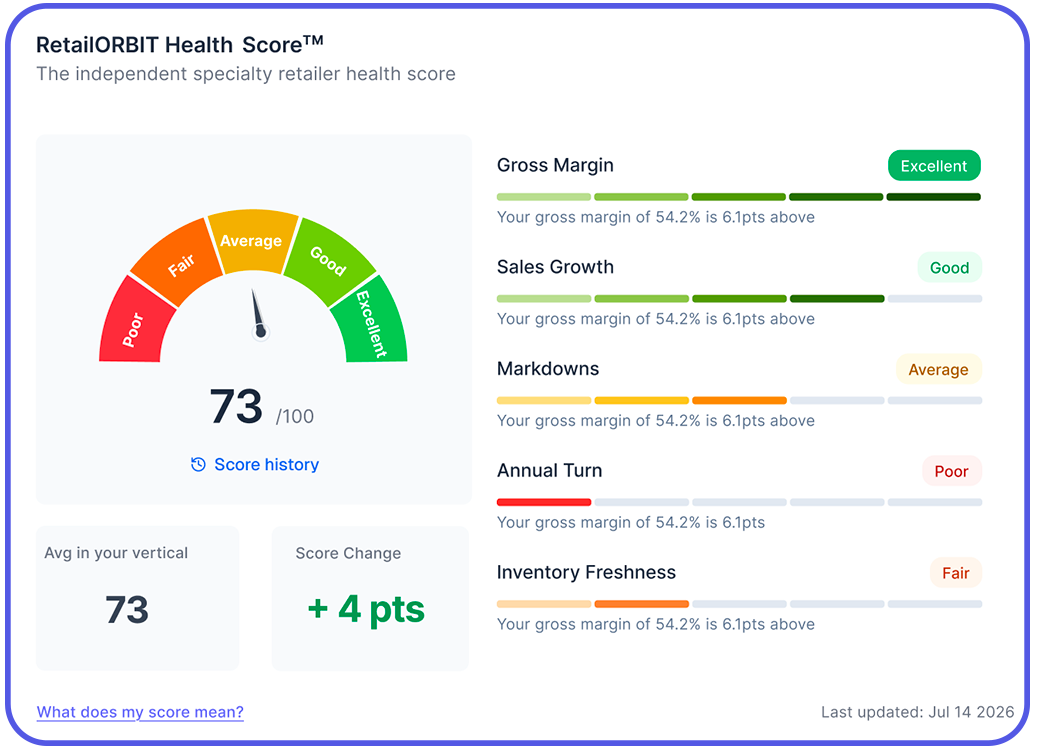
That gap is why we built the Retail ORBIT Health Score. It takes the story of your buying, planning, and inventory and puts it into one number from 0 to 100, benchmarked to your vertical and refreshed monthly. One number gets your attention. The five measures behind it tell you what to do about it.
A Headline Is Not a Diagnosis
Imagine a doctor who looked at your chart and said only, “You are a 73.” Your first question would be what is pulling it down. That is exactly the right instinct. The score is the headline. The components are the story.
Each of the five measures answers a different question about your business, and each one can fool you if you read it alone. Let us walk through them.
1. Gross Margin: What Is Left to Run the Business
Gross margin is what remains after you pay for the goods, and it is the money that covers everything else: rent, payroll, marketing, and your own paycheck. It starts at the buy. Initial markup, vendor terms, and freight set the ceiling. Markdowns and shrink wear it down.
Where it can mislead: A strong margin can hide a problem, because the products carrying your highest margin may also be your slowest sellers. Margin only counts once the product actually sells.
What to do: Look at margin by class, not just in total. A healthy average can hide one class that is quietly bleeding.
2. Sales Growth: The Most Flattering Number in Retail
Growth is easy to love and easy to misread. Up is not automatically good. Growth bought with heavy discounting, or with inventory you cannot afford to carry, can cost more than it earns. Down is not automatically bad either. You may be stepping away from lines that never made you money.
Where it can mislead: Comparing only to last year. Last year may have been unusual, which is why it helps to compare against your plan and against retailers like you.
What to do: Read growth next to the other four measures. Growth with healthy margin and turn is progress. Growth without them is just activity.
3. Markdowns: The Price of a Miss
Markdowns are what you pay for a buying mistake or a timing mistake… and yes, some are healthy! They clear room for fresh goods and keep customers engaged. Too many tell you the buy missed the mark. Too few can mean you are holding onto dead stock out of hope, or pride.
Where it can mislead: A low markdown rate looks like discipline, but it can also mean you are not clearing what needs to go.
What to do: Decide your rules before the season starts. When will you cut, how deep, and who makes the call? A markdown taken early costs far less than the same markdown taken late.
4. Annual Turn: Cash in Motion
Turn tells you how many times a year your inventory sells through and gets replaced. It is a cash number as much as a merchandise number, because every dollar sitting on a shelf is a dollar you cannot spend on something fresh. If you want a refresher, here is our definition of inventory turnover.
Where it can mislead: Turn is an average, and averages hide things. Fast sellers you keep running out of and slow sellers you cannot move can net out to a respectable turn. A turn that is too high can also mean you are under-stocked and leaving sales on the table.
What to do: Pair turn with class-level views, and judge it against your own vertical. A turn that is excellent for a furniture store would be a warning sign for a gift shop.
5. Inventory Freshness: The Early Warning
Freshness asks how much of what you own is new, relevant, and selling, versus aged. Customers return to a store that gives them something new to see. Aged inventory ties up cash, invites markdowns, and makes a store feel tired.
Of the five, freshness is often the earliest signal. Aging shows up on your shelves long before it shows up in your financial statements. By the time margin and markdowns reflect it, the damage is already done.
What to do: Protect dollars for fresh goods. That means holding open-to-buy back, resisting the urge to front-load, and moving aged product on a schedule rather than when it becomes painful.
The Real Value Is in the Pattern
Any one of these numbers can look fine while the business is in trouble. The value comes from reading them together.
• Strong margin with weak turn usually means you are buying well but buying too deep.
• Good growth with heavy markdowns usually means you are buying your sales rather than earning them.
• Healthy turn with poor freshness usually means you are selling your core but not renewing it.
A single metric can send you chasing the wrong problem. A pattern points you to the right one.
Why the Comparison Matters
Most owners eventually ask the same question: is this normal for a business like mine? Without a benchmark, you are left guessing. A score compared against your vertical answers that question and keeps you from measuring a shoe store against a toy store. It also tells you where you have real room to improve, which is different from where you simply look different.
What to Do With Your Score
Do not try to fix five things at once. Pick the lowest-rated measure, name one action that moves it, and give it a quarter. If markdowns are the problem, the action might be an earlier cutoff for slow sellers. If turn is the problem, it might be smaller opening orders with room to reorder. Then check again next month.
The goal is not a perfect score. The goal is to know where you stand and to move while there is still time for it to matter. Like any risk in your business, a number you read once a year is a photograph. A number you read monthly is a film, and it lets you act while there is still room to change the ending.
Start Where You Are
If you have never looked at your business this way, start now. Your Retail ORBIT Health Score gives you a snapshot of these five measures and shows you where you stand against retailers like you. Take it into a conversation with someone who can help you read it, and pick your first move.
Healthy retail is not an accident. It is a series of small, well-timed decisions made by someone who knows what the numbers are saying.Onwards and Upwards,
Marc Weiss
Co-founder and CEO
Management One
|
Pass It Along
Know another retailer who'd want this in their inbox?
We send a read like this regularly including a variety of topics indie retailers like you care about: what we're seeing across the community, what's working, what's not, and what to do about it. Forward this post, or sign up below to get it straight from us.
|